Most founders allocate their tech budget the way they shop at Costco: spread it across categories, take what looks cheap, never check the total. The startups that compound do the opposite. They allocate aggressively to one category and starve everything else.
The category matters.
01How most founders allocate
We've seen this split across dozens of early-stage startups. ~40% of monthly tech budget goes to SaaS — analytics tools, project management, every "founder essentials stack" on Twitter. Another 25% to marketing — ads, email tools, conversion optimization. People (developers, designers, the team that actually ships) get 20%. Infra and ops split the last 15%.
The problem isn't that any one number is wrong. It's that the only line item that compounds is the one with the smallest budget. Tools depreciate. Ads disappear when you stop paying. Infra is mostly fixed. People — and the team that holds context — is the only line where last month's spend produces this month's output without re-spending.
02How operators allocate
Founders who've run profitable startups before flip this:
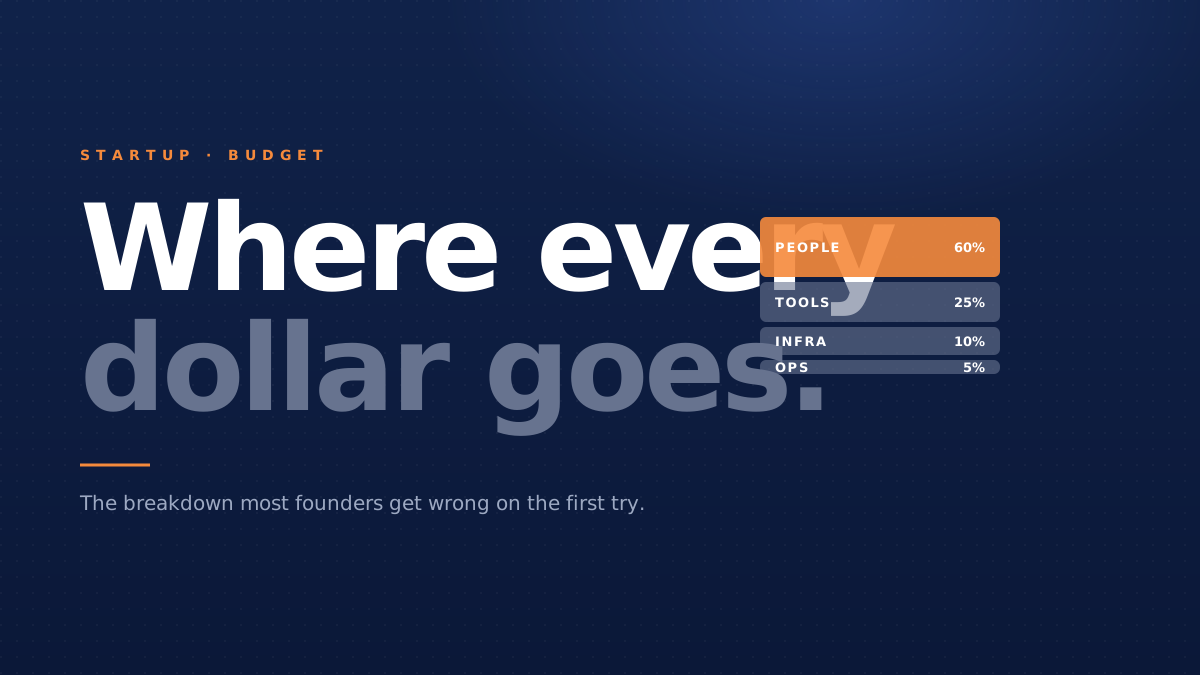
- People — 60%. This includes the ready team, specialized contractors for one-shots, and any in-house hires. They build the things that exist next month
- Tools — 20%. Just enough. Slack, Notion, the analytics stack, one ad platform. No "shiny new SaaS Tuesday" subscriptions
- Marketing — 12%. Mostly for the cost of running existing channels — not for testing 8 new ones
- Infra — 6%. Hosting, monitoring, security. Stable, boring, mostly automated
- Ops — 2%. The rest — accounting software, contracts, basic admin
The 60/20/12/6/2 split looks aggressive on paper. In practice it's how the startups that survive past month 18 actually spend.
03Why this ratio compounds
Every month, the 60% on people produces:
- Code that's still running next month
- Customer relationships that hold through the next quarter
- Operational knowledge that doesn't reset when a tool changes
- Internal standards and decisions that scale with the team
None of these survive in the 40% tools-and-marketing allocation. SaaS subscriptions are pure operating cost — they buy a service, not an asset. Ads are pure operating cost — they buy clicks, not customers (until you build something that converts the clicks, which is people work). Marketing tools without people to operate them are expensive parked cars.
04When the typical allocation is correct
The 40% tools / 25% marketing split is right for businesses where the product is fully automated and the human bottleneck is acquiring users. That's a small number of consumer SaaS plays with very low ARPU.
For everything else — B2B SaaS, services, marketplaces, anything with even moderate customer touch — the operator ratio applies. Most startups think they're the first category. Most are the second.
05The "ready team as line item" question
The 60% on people raises a budget question: hire in-house or use a ready team?
At pre-PMF and early stages, the ready team subscription typically dominates in-house hiring on the per-dollar output. You're paying for capacity without taking on equity dilution, payroll overhead, or 90-day ramp time on each new hire. Once you're past $2M ARR and clear on which roles need a permanent owner, in-house starts to win for some roles (not all — most companies over-rotate to in-house and discover it doesn't suit ops, design, or specialized engineering).
The cleanest pattern: subscribe to the ready team until specific roles develop a clear long-term ownership case, then in-house just those roles. Everything else stays on subscription.
06What to do this week
Pull the last 90 days of tech-related spend. Tag every line item as one of: People · Tools · Marketing · Infra · Ops. Add them up.
If your People line is under 40%, you're allocating like a typical founder, not like an operator. Move budget into People until the ratio shifts. The fastest path is usually subscribing to a ready team and canceling 2-3 SaaS subscriptions you don't actually use.
The free founder tech audit has a 5-question allocation diagnostic that tells you which of the five buckets is currently bleeding the most — typically Tools or Marketing without anyone owning them.