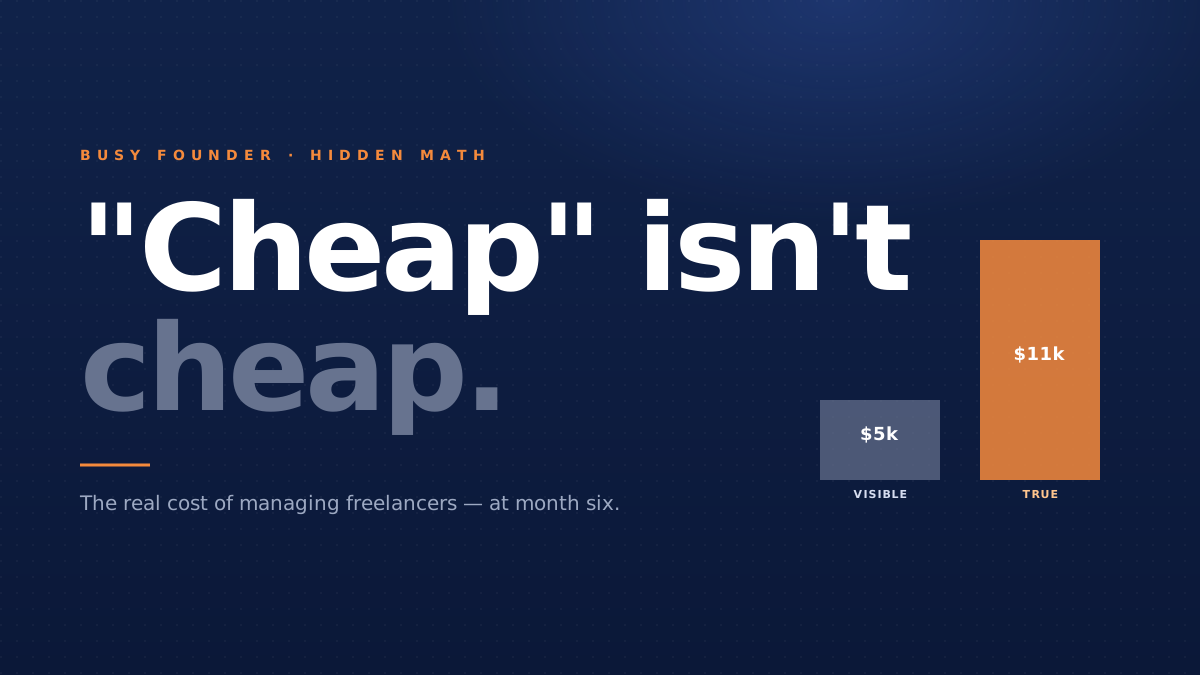
When a busy founder says "I'm saving money with freelancers," the spreadsheet usually shows the rate. It rarely shows the actual cost.
The visible cost is the hourly rate. The hidden cost is everything that has to happen around the hourly rate for the work to land. By month four, the hidden cost has caught up. By month six, it's larger than the visible cost.
This is the part nobody mentions in the "go cheap with freelancers" advice.
01What you pay vs what it costs
Run the math on a typical solo-founder freelance setup at $5,000/month visible cost:
- Coordination overhead — the time you spend lining up the next sprint, briefing each freelancer, juggling tools. At a busy founder's effective $200/hr, that's 9 hours = $1,800
- Context loss / rework — every quarter you change a freelancer or add a new one. The new person needs onboarding, fixes things in non-standard ways, builds in their own preference. Roughly $1,400/month amortized
- Founder review + approval time — the actual hours you spend in approval threads, code reviews, async clarifications. 16 hours × $200 = $3,200
Total true cost: $11,400/month for what looked like a $5,000 line item.
Now compare to a ready tech team at $4,500-6,500/month. The team holds context, owns coordination, runs the brief themselves. The visible cost is similar to or higher than freelancers. The true cost is roughly half.
This is why the spreadsheet lies. The visible cost is the only number on it.
02Why coordination cost compounds
Coordination grows with the square of the team size, not linearly. Two freelancers = 1 connection. Three = 3. Four = 6. Five = 10. Each new connection is another channel you maintain, another brief that needs syncing, another tool you might have to log into.
At three freelancers, busy founders typically describe their week as "managing." At five, the founder is the bottleneck. At seven, the team produces less output than it did at three because the founder can't keep up.
The ready team model side-steps this by collapsing all those connections into one. You have one contact. They run the internal coordination. Your coordination cost stays at "one connection" no matter how big the team behind it is.
03When freelancers are still the right call
Freelancers are still the right pick when:
- You need a single specialist for a single deliverable. A logo. A brand guide. A landing page. One person, one outcome, one invoice. Coordination cost is near zero because there's only one connection
- The work is genuinely modular and doesn't touch your core product. A blog post. A research report. A one-time integration
- You have someone in-house who manages the freelance bench. A CTO, a head of ops, anyone whose job is partly to absorb the coordination cost so it doesn't fall on you
If none of those apply, the freelance model is leaking energy and money in places you're not measuring.
04What to do this week
Pull last month's freelance invoices. Add up the visible cost. Then add:
- Hours you spent in Slack/email with each (× your effective hourly rate)
- Hours spent re-explaining context (× your effective hourly rate)
- Approximate rework cost when one person built something the other had to redo
If the true number is more than 1.6× the visible number, the model is broken. If it's more than 2×, switching to a ready tech team is strictly cheaper.
The free founder tech audit has a specific calculator — five questions — that gives you the true vs visible ratio in about 20 minutes.