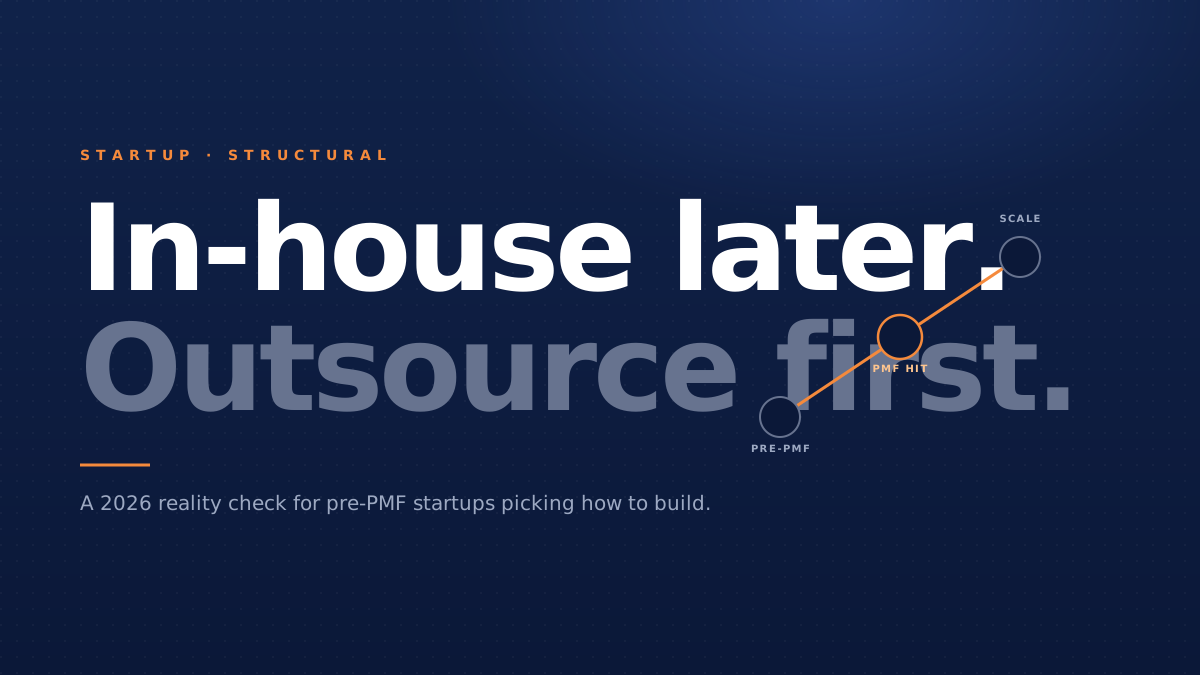
Every founder I meet wants an in-house team. The aspiration is reasonable. The timing usually isn't.
Pre-PMF, in-house is a bad bet. The math is bad, the politics are bad, and the flexibility you give up is exactly the flexibility you need most. Post-PMF, in-house starts making sense — for specific roles, in specific orders.
The trick is knowing which side of the line you're on.
01When in-house actually wins
The line is more concrete than founders think. There are two specific gates:
Gate 1 — Product-market fit. Defined narrowly: you have a repeatable acquisition motion and customers stick. If you can't yet describe who your customer is in one sentence and how they find you in another, you don't have PMF. In-housing engineering before this point is paying for production at full capacity while the product is still in research mode
Gate 2 — ~$2M ARR. This is when in-house starts paying for itself for some roles. Why $2M? Because that's roughly when individual role-ownership becomes legible. Before that, every role is "everything." After that, a CTO can own architecture, a head of growth can own acquisition, a head of CS can own retention. They become coherent jobs
Most founders try to hire in-house between these two gates — after the seed round, before PMF. That's the worst window. You have capital, the product isn't proven, and you're locked into salary obligations on roles that haven't crystallized yet.
02The math pre-PMF
Hiring three in-house developers at $130k average + benefits + equity + 90-day ramp time = roughly $480k for the first year. None of which is reversible.
A ready tech team at $6,000/month delivers similar production capacity for $72k. Zero equity. Cancel anytime. The team can pivot when your roadmap pivots because they aren't structurally locked to the previous direction.
Pre-PMF, where the roadmap pivots every 6-10 weeks, the flexibility ratio is even more important than the cost ratio. In-house teams resist pivots because each pivot looks like wasted effort. Outsourced teams pivot smoothly because the business model is capacity, not a specific roadmap.
03The 2026 reality
A lot of "you must hire in-house" advice was written in 2018-2021 when capital was cheap, equity dilution was easy to swallow, and roles like "Head of Growth" were treated as identity. None of that holds in 2026:
- Capital is more expensive, so equity is more valuable to preserve
- The default expectation that a founder has 8 in-house FTEs at seed stage is gone
- Distributed/remote-first teams have proven that "the team isn't on payroll" doesn't mean "the team isn't on the team"
The market quietly moved. Many of the highest-output early-stage startups in 2026 are running outsourced or hybrid teams through PMF, in-housing one role at a time after $2M ARR.
04The hybrid pattern that actually works
The cleanest path most founders we work with land on:
- Pre-PMF → ready team handles all engineering, design, and ops capacity. Founder owns product + GTM
- Hit PMF → in-house one role: usually the first engineering hire who'll own the codebase as it scales
- Hit $2M ARR → in-house the second role: usually growth or CS, whichever is the binding constraint
- Hit $5M ARR → in-house more selectively. Keep ready team subscribed for capacity peaks, design, and specialized work
This pattern is roughly 50% the cost of in-house-everything for the same trajectory. The ready team becomes the "always there" capacity layer that absorbs spikes and frees the in-house team to focus on long-term ownership.
05What to do this week
Honest answer to three questions:
- Do you have PMF? (One sentence describing the customer. One describing how they find you. If no, skip to #3)
- Are you above $2M ARR? (If yes and you're outsourced everything, start scoping one in-house role. If no, hold)
- If neither, what's your runway? (Below 12 months: outsource. Above 12 months: still outsource — you'll save the runway)
The free founder tech audit has a structured 4-question diagnostic for this — gives you a clear answer about which gate you're at without the wishful thinking that usually colors the call.