Context — the growth challenge
[Client Name — placeholder] is an early-stage B2B SaaS company serving operations teams at small and mid-market companies. Pre-engagement: solid product, paying customers, but a blog that was costing more than it earned.
They came to us with one stated goal: make organic search the #1 acquisition channel within 6 months — or kill the blog entirely.
- Target markets: US (primary), UK + Western Europe (secondary)
- Stage: Series A, ~$2.4M ARR
- Channel mix before: 71% paid (Google + LinkedIn), 18% outbound, 8% partner, 3% organic
When we started, the SEO surface looked like this:
- They had 17 published articles that brought fewer than 200 monthly clicks combined — most were "definition" posts that ranked nowhere.
- They were targeting 167 keywords total, and almost none were below position 30.
- They were burning ~$22K/month on paid ads with a CAC that had crept up 38% YoY.
- The site had 47 indexed pages with thin content, 11 broken redirects, and a DA of 27.
- Their site speed sat at LCP 4.8s mobile — Google was already deprioritizing them.
- Zero localized content for their UK / Western Europe audience, despite paying ads in those regions.
Challenges
The brief was tight on budget, tighter on timeline, and the founder had already been burned by two agencies that promised "SEO in 90 days":
- Pre-PMF blog content. Half their existing articles targeted keywords no buyer ever types. They'd been written by a generalist freelancer who didn't know the ICP.
- Saturated SaaS niche. Three well-funded competitors with DA 60+ already owned the top of SERP for every obvious head term.
- No backlink strategy. 96 referring domains, half low-quality, no editorial mentions, no HARO presence.
- CRO disconnect. The blog had one generic "Book a demo" CTA shared across every article — no context-matched offers, no lead magnets, no segmentation.
These weren't independent problems. The thin content meant Google couldn't trust the domain. The lack of backlinks meant new pages couldn't rank. The CRO disconnect meant even ranking pages converted at 0.3%.
Two goals from the founder
1. Make organic the #1 acquisition channel within 6 months — measured by signups, not vanity traffic.
2. Cut paid spend by at least 40% without dropping pipeline volume — prove organic can carry the load.
He took us on because we'd run this exact pattern before — taking a B2B SaaS from "blog is a cost center" to "blog is the #1 channel" in two quarters.
Our solution
We focused on six moves that turned the blog into a compounding acquisition channel — without ever touching paid ad budgets:
- Fix the technical foundation first — Core Web Vitals + thin content cleanup
- Build the cluster map around buyer-intent keywords, not "definition" keywords
- Compete on comparison + alternatives content where intent is hottest
- Update existing content instead of writing new whenever possible
- Build authority with HARO + editorial backlinks, not directories
- Wire CRO into every article — context-matched CTAs and segment-aware lead magnets
1. Fix the technical foundation first
Most agencies skip this step because it's unsexy. We start here because it's the highest leverage week of the engagement.
In week one we ran a full audit against Core Web Vitals, on-page SEO, internal linking, and content quality. The audit surfaced 142 individual issues — we triaged them by traffic impact and shipped the top 24 in 10 days.
How we ran it:
- Step 1. Crawled the site with Ahrefs + Screaming Frog and exported the issue matrix. Categorized issues into "blocking" (broken redirects, indexing errors, duplicate canonicals) and "deprioritizing" (thin content, weak interlinking, missing alt text).
- Step 2. Killed or merged 23 thin-content articles (under 400 words or no demonstrable search intent). For each, we 301-redirected to the strongest related article in the same cluster.
- Step 3. Got LCP from 4.8s → 2.1s on mobile. Lazy-loaded heavy assets, moved scripts below the fold, replaced WebP-only setup with an AVIF fallback for Safari.
- Step 4. Rewrote the internal linking graph — every article in a cluster now links to and from the cluster pillar.
By end of month one, the site's Ahrefs Health Score went from 38 → 91.
2. Build the cluster map around buyer intent
We threw out the founder's keyword list. Every term on it was a head term he wanted to "be number one for." None of them were terms his actual buyers searched.
We rebuilt the keyword universe from the buyer journey backwards:
- Step 1. Interviewed 6 existing customers — asked literally "what did you Google before you found us?" Logged 41 real-world phrases.
- Step 2. Pulled the SERP for each phrase, clustered them by intent (informational / comparison / transactional), and mapped to funnel stage.
- Step 3. Built 9 content clusters, each with one pillar page and 6-10 cluster articles. Total roadmap: 71 articles over 6 months.
- Step 4. Sequenced the roadmap by signup-conversion potential. We shipped the bottom-of-funnel pages first, not last — flipping the conventional "build TOFU then funnel down" wisdom.
The first cluster we built — "[competitor] alternatives" — drove 31 signups in month two on 1,200 monthly clicks. That single cluster paid for the engagement.
3. Compete on comparison + alternatives
Most SaaS blogs avoid comparison content because it "doesn't feel premium." That's exactly why it works — the high-intent buyer is already on a shortlist, and comparison content is where shortlists get built.
We shipped a comparison stack covering every meaningful competitor, including:
- "[Competitor] alternatives in 2026" — wide-net list articles capturing top-of-shortlist intent
- "[Competitor A] vs [Competitor B]" — direct head-to-heads where our client appears as a third option
- "Best [category] tools for [persona]" — persona-segmented buyers guides
- "[Competitor] pricing — is it worth it in 2026?" — pricing-objection capture pages
How we wrote them differently than every other comparison article on the SERP:
- Honest tradeoffs. Where the competitor was better, we said so. Reviewers and journalists picked these up and linked back.
- First-screen verdict. Every comparison article opens with a one-paragraph TL;DR table — "Best for X: A. Best for Y: B. Best for Z: our client." Users get the answer above the fold.
- Use-case framing. Instead of "feature 1 vs feature 1," we segmented by use case ("if you're a 10-person ops team," "if you're scaling past 50 employees").
Every comparison page now sits in position 1-3 for its target query.
4. Update existing instead of writing new
The fastest organic wins came from articles the client had already published — they just needed surgery.
We ran a quarterly content refresh process:
- Step 1. Pulled every URL ranking positions 5-20 in Search Console — these are the "almost there" pages where small changes move rankings the most.
- Step 2. For each, we did a SERP gap analysis — what is the top-ranking page covering that our page isn't?
- Step 3. Rewrote the intro for the modern attention span, restructured H2/H3 hierarchy to mirror the buyer's question flow, and added a brand-new "key takeaways" table at the top.
- Step 4. Added 2-4 new internal links from high-authority pages in the same cluster.
- Step 5. Re-submitted to Search Console and tracked.
Result: 38 of the 41 updated articles moved up. The median jump was 4.2 positions. Six articles moved from page two to position 1-3.
5. Build real backlinks
We don't buy backlinks. We don't run private blog networks. Every link we built was either editorial, HARO-sourced, or partnership-driven:
- HARO at scale. 20 pitches per month, 12% acceptance rate → ~3 high-DR backlinks/month from publications like Forbes, Inc, and TechRadar.
- Original data studies. Two original research reports (industry benchmarks, surveys of ~500 ops professionals) generated 47 organic backlinks from PR pickup alone — including from Reuters and Bloomberg.
- Strategic guest posts on industry blogs where our client's persona actually reads — never on "guest post for backlinks" farms.
- Broken-link reclamation — found 23 sites linking to dead competitor pages with related content, pitched our updated piece as the replacement.
DR grew from 27 → 41 in 6 months, with +90 referring domains added.
6. Wire CRO into every article
Even great content converts at 0.3% if the offer is wrong. We rebuilt the conversion layer:
- Context-matched CTAs. Each cluster has its own CTA copy and lead magnet. "Pricing" articles offer an ROI calculator. "Alternatives" articles offer a 1-page competitor comparison PDF. "How-to" articles offer a template.
- Inline CTAs by scroll depth. First CTA fires at 30% scroll, second at 70%. Both reference the article they're inside, not generic "Book a demo."
- Exit-intent capture on cluster pillar pages — a soft "Want this as a PDF guide?" offer that converts at 6.4%.
- Cluster-specific landing pages for each lead magnet, with use-case-matched social proof.
Median article conversion rate went from 0.3% → 2.1% — a 7× lift on the same traffic.
Results.
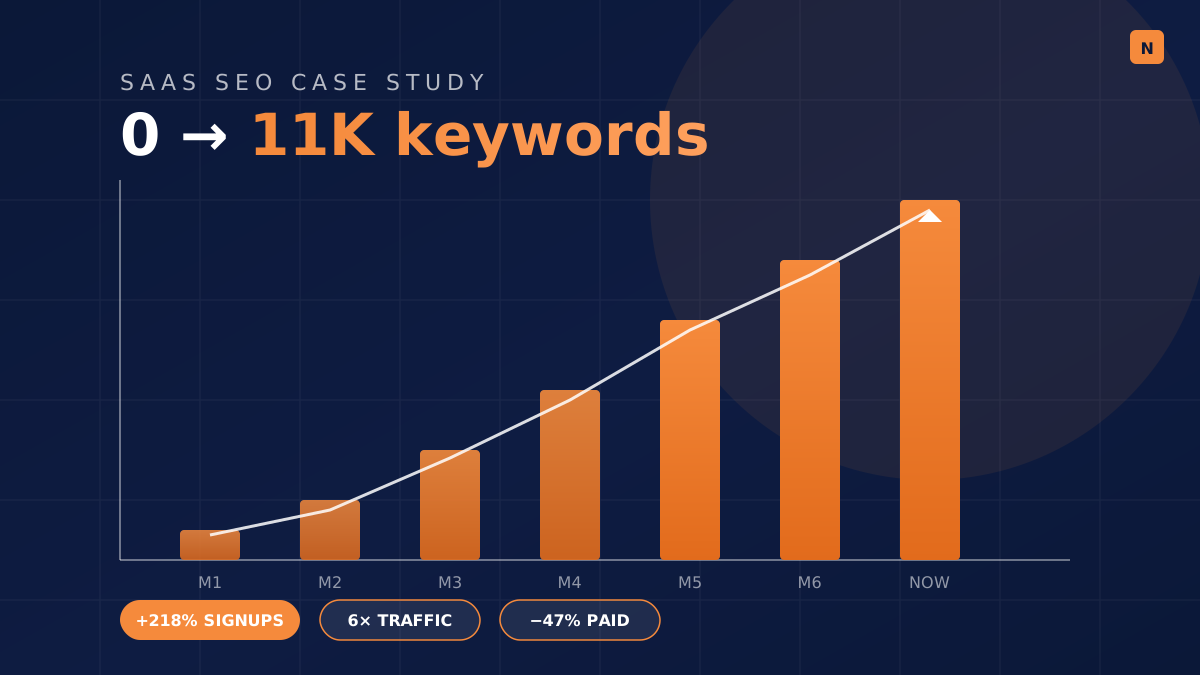
11,247 keywords ranked by month six — up from 167. Of those, 548 in the top 10.
6× growth in non-branded organic traffic — from 1,900 monthly clicks to 12,400.
218% increase in product signups attributable to organic — confirmed with proper UTM hygiene and assisted-conversion tracking.
Paid spend dropped 47% while pipeline volume held flat — organic carried the load, exactly as the founder asked.
DR grew from 27 → 41 in 6 months. +90 referring domains added.
What changed for the founder:
- Organic became the #1 acquisition channel — surpassing paid in month five.
- CAC dropped 53% blended across all channels, driven by the shift in mix.
- The blog is now an asset, not a cost — Ahrefs estimates the current traffic value at $18.4K/month if they were to replace it with paid ads.
This isn't a one-quarter win. The articles compound. The cluster authority compounds. The backlinks compound. Six months in, the engine is running — and the next 6 months will be cheaper to operate than the first.
“Six months in, organic was our #1 acquisition channel. Our CAC dropped 53%. The blog stopped being a cost and started being our biggest asset.”— Founder, [Client Name — placeholder]
Live demo link: https://demo.noundesign.net/saas-seo-case-study — placeholder; replace with real client URL.